Not every enquiry comes from someone planning to place an order.
Manufacturers often discover this only after the sales team starts calling. The lead may have a real company name, a working phone number and a product request that appears relevant. Then the conversation goes somewhere else. The person was checking prices for a customer, looking for information for a future project, trying to understand the market, or filling out a form without any immediate purchase behind it.
That can make the lead generation report look healthier than the sales pipeline actually is.
The problem gets especially noticeable when sales receives a steady flow of enquiries but has to spend a lot of time figuring out which ones represent a real requirement. Some of those leads will turn out to be perfectly legitimate opportunities. Others were never close to becoming a purchase in the first place.
Understanding why that happens starts with looking at what a B2B enquiry actually represents.
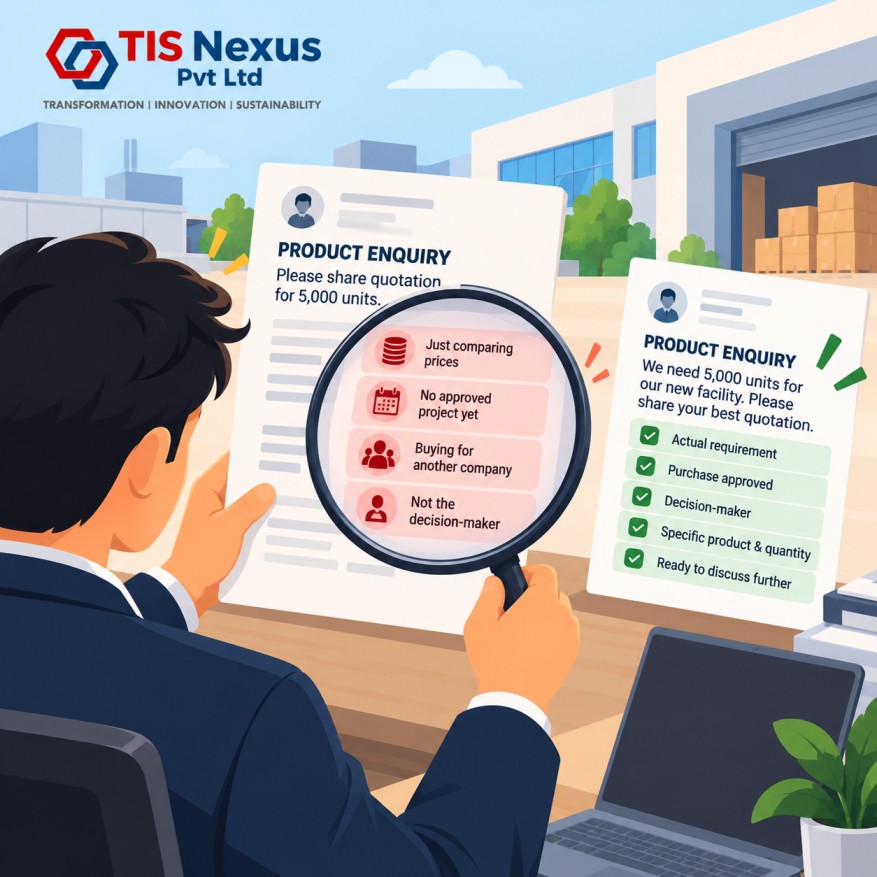
A product enquiry can come from several different situations
When someone contacts a manufacturer, the message usually gives very little background.
They may ask for a catalogue, product details, specifications or a quotation. Sometimes there is a quantity attached. Sometimes there is not. From the outside, several very different buying situations can produce almost the same enquiry.
A procurement employee may be preparing for a future purchase and collecting supplier information. A distributor may be looking for a manufacturer to fulfil an order from its own customer. A consultant could be gathering technical information before a client makes a decision. Someone may also be doing simple market research with no project approved yet.
The manufacturer has no way of knowing which situation it is dealing with until somebody asks.
This is one reason an enquiry should not immediately be treated as a sales opportunity simply because the contact requested information.
Some people are researching long before they are ready
B2B purchasing often starts well before procurement is ready to place an order.
A company may be planning a new facility, evaluating a product category or reviewing its existing suppliers. At that stage, somebody has to gather information. They may contact several manufacturers, ask about specifications and request indicative pricing so that the company can understand what is available.
The person doing this work can be completely genuine.
They are still not necessarily a buyer in the sense that sales teams usually mean when they talk about a qualified opportunity.
Consider a manufacturer receiving an enquiry for industrial equipment. The contact asks for technical details and a quotation, but during the call explains that management is still deciding whether the project will go ahead. There is no purchase date yet, and the specification may change.
The enquiry has a real business reason behind it. It simply belongs to an earlier stage of the buying process.
That distinction matters because sales should not spend the same amount of time on every type of enquiry.
There is also the person buying for someone else
Intermediaries create another layer.
A trader, distributor or sourcing representative may actively want the product. They could be looking for a supplier because one of their customers has asked them to arrange the purchase. From the manufacturer's perspective, there is a genuine commercial conversation taking place.
The confusion begins when that contact is assumed to be the final buyer.
A salesperson may ask about the intended application and hear, “My customer needs it.” A quantity may still be under discussion. The specification could be waiting for approval from another company. Even after the quotation is sent, the contact may say they need to forward it before they can confirm anything.
None of this means the lead is fake.
It means another organisation is involved in the purchase, and the manufacturer should know that before deciding how to handle the account.
A distributor can become a regular customer. A trader may place the order itself. A sourcing company may be managing procurement on behalf of several businesses. The important thing is that the role is clear.
Sometimes the company is right and the contact is wrong
Manufacturers also receive enquiries from companies that genuinely could buy their products, only to discover that the person who submitted the enquiry has no role in purchasing.
This can happen for ordinary reasons.
An employee may have been asked to find supplier information. Someone from administration may have forwarded a form internally. A person in sales may be exploring suppliers for a new product line while procurement handles the actual order.
A suitable job title does not solve this automatically either. A contact can hold a senior position and still have little involvement in a particular purchase. Likewise, somebody with a less obvious title may be the person who handles sourcing for the company.
The first call often reveals the situation. The person may say that procurement handles the order, or that the technical team needs to review the product before purchasing can proceed.
That is useful information. Sales now knows where the real conversation belongs.
Generic requests can hide very different intentions
“Please send your product catalogue” is one of the most common kinds of B2B enquiry.
It is also one of the least informative.
A genuine buyer may request a catalogue because they are still deciding which model or specification they need. A distributor may want to understand the manufacturer's full product range. Another contact may simply be gathering information for a project that has not been approved.
The request itself does not tell sales enough.
The conversation becomes clearer when the salesperson asks what prompted the enquiry and which product the company is currently considering. Even a rough answer can help. A buyer may know that a particular product is needed for an existing operation. Someone doing broad research may not be able to explain much beyond the category.
That difference is easy to miss when lead generation is judged from the number of forms received.
Price enquiries can look more serious than they are
A request for pricing often gets immediate attention from sales, especially when the person sounds specific.
But a price request does not necessarily mean an order is close.
One contact may have an active requirement and need a formal quotation. Another may be collecting supplier prices before speaking to a customer. Someone else may be trying to understand the going rate for a product they have not decided to purchase.
The surrounding questions matter.
If the contact can discuss quantity, specification, delivery location or intended use, there is some substance behind the enquiry. When the only request is for a rate and there is no explanation of what will happen after the price is received, sales has very little context.
That does not mean the contact should be dismissed. The salesperson simply needs to understand what the quotation is for before putting too much weight on it.
Timing creates a surprising number of “bad leads”
Some enquiries become inactive because the need disappeared after the lead was created.
A project may have been postponed. A customer may have cancelled an order. A budget may have been delayed. The employee who made the enquiry may have moved to another role.
Months later, the same company can appear in a lead report and nobody remembers what originally happened.
There are also cases where the original requirement was real but the purchase was never immediate. A manufacturer may be speaking to a buyer who is gathering suppliers for the next procurement cycle rather than this month's order.
From the outside, both situations can look like poor lead quality.
The difference comes from the reason the contact reached out and what the company is doing now.
That is why old leads can become difficult to judge simply from the information stored in a spreadsheet. Without some context, a salesperson cannot tell whether the prospect went cold or whether the purchase was never expected to happen yet.
A lot of filtering happens after the lead arrives
This is where the gap between lead volume and useful sales conversations becomes obvious.
Marketing or lead generation may report that a large number of enquiries came in during the month. Sales opens the list and starts calling. Some contacts do not answer. Some belong to people who have moved companies. A few companies are relevant, but the contact is from the wrong department. Others are interested in the product but have no current requirement.
By the time the sales team has worked through the list, only part of it may feel worth serious follow-up.
There is nothing unusual about sales filtering leads. Every business has to do some of it. The concern is when the team is spending a significant amount of its time discovering basic information that should have been understood before the lead reached the pipeline.
At that point, the manufacturer is not simply dealing with a follow-up problem. There may be a lead-sourcing problem underneath it.
The source can tell you more than the individual lead
Manufacturers sometimes examine unsuccessful enquiries one by one and never look for the wider pattern.
Suppose sales repeatedly receives contacts from companies that have no connection with the product. Or a large share of enquiries come from people who are collecting information for another business. Perhaps the phone numbers are valid, but the contacts have little involvement in purchasing.
A recurring pattern like that deserves attention.
It may show that the wrong type of company is being targeted. It may point to a gap in the way contacts are selected. In some cases, the issue could simply be that the business is attracting people who want information rather than people with an active requirement.
Looking at the source of the lead helps separate an occasional weak enquiry from a repeatable problem.
A buyer should have some reason to be speaking with the manufacturer
There is no single question that can identify a genuine buyer.
The useful information comes from several ordinary parts of the conversation. Why does the company need the product? Who uses it? Who handles the purchase? Is the requirement for the company itself or for one of its customers?
The answers do not need to be perfect.
A procurement contact might not know the final quantity. A project manager may need to confirm the specification with engineering. A company owner may be discussing a purchase that still needs approval from a partner.
Those are normal situations.
What raises concern is when there is no clear connection between the company and the product at all, or when every meaningful detail belongs to somebody else. In that case, sales should know what sits behind the contact before treating it as a direct buyer opportunity.
Verification has limits
Even a carefully checked lead can change after it enters the pipeline.
A company can have a genuine requirement and later put the project on hold. A buyer can lose internal approval. A distributor can decide to use another supplier. Someone who appeared responsible for procurement can move to another department.
Verification reduces uncertainty around the contact and the company. It cannot control what happens afterward.
That is an important distinction because manufacturers sometimes expect a verified lead to behave like a guaranteed sales opportunity. No lead source can remove the uncertainty that naturally exists in business purchasing.
The useful standard is much simpler: when sales receives the lead, the basic story should make sense.
Good buyer sourcing gives sales a starting point
For manufacturers, the difference between a contact and a useful B2B lead often comes down to context.
Sales needs to know why the company belongs in the target market and why the particular person is worth contacting. If there is a requirement, the team needs at least some idea of what that requirement is. When another company is involved, that relationship should be visible.
This is the kind of information that makes TIS Nexus relevant to businesses looking at B2B buyer sourcing. The work is not simply about finding contact details and adding more rows to a database. The manufacturer still needs to know what sits behind those contacts once the leads reach sales.
A good lead may still need qualification. It may not turn into an order. The buyer may change direction during the process. Those things are part of B2B sales.
What should not happen repeatedly is sales discovering that there was never a meaningful buying conversation to begin with.
The first call usually tells the story
Most misleading enquiries do not stay mysterious for very long.
The salesperson asks why the company is looking, and the contact explains that the project is still being discussed. Or the person says they are sourcing for a customer. Maybe they redirect the call to procurement. Perhaps they admit that they were only checking product information.
All of those answers are useful because they tell sales what the lead actually is.
The manufacturer can then decide how to continue the conversation, when to follow up, or whether the contact belongs in the active pipeline at all.
For businesses building their buyer pipeline through TIS Nexus, that distinction remains important after the lead has been generated. The value of a buyer enquiry becomes much clearer once sales knows what the company needs, who is involved and why the conversation started.
A person asking for a quotation may be ready to buy.
They may also be three conversations away from knowing whether they will buy anything at all.