Not every enquiry is a buying enquiry.
A manufacturer can receive a message from a company that looks relevant, asks for product details and even requests a quotation. Sales follows up, expecting a conversation about the requirement, only to discover that the person was collecting prices for somebody else, researching the market, looking for a supplier to add to a list, or simply making an enquiry with no purchase planned at all.
It is frustrating because the lead itself may look perfectly legitimate in a report. There may be a company name, a phone number, an email address and a product request. The problem only becomes visible once somebody starts talking to the contact.
That usually means the gap is not in whether an enquiry was generated. It is in what was counted as an enquiry in the first place.
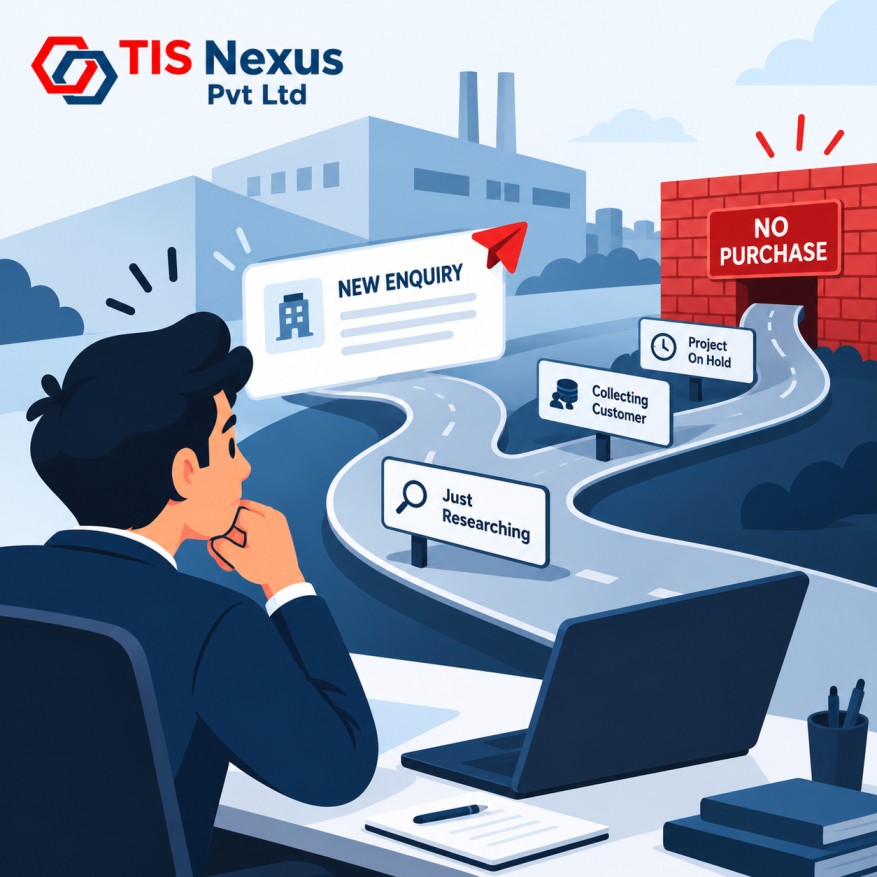
A product enquiry can mean several different things
When someone asks a manufacturer for product information, there is no guarantee that an order sits behind the request.
The person may be looking for a product for their own company. They could be sourcing it for a client. They might be a distributor trying to understand supplier options. In some cases, they are simply checking what products are available before they make a decision internally.
These situations can all produce almost identical messages.
"Please share your catalogue."
"Send specifications and pricing."
"Can you supply this product?"
Those lines tell sales what the person is asking for. They do not explain why the person is asking.
That missing piece matters because the salesperson will approach the lead differently once the reason becomes clear. A company planning a purchase needs a useful sales conversation. Someone gathering information for a future project may need a follow-up later. A sourcing intermediary may require a different relationship altogether.
Treating all three as the same type of lead creates confusion very quickly.
Some people are looking for information, not a supplier
There is a lot of research that happens before a B2B purchase becomes a real procurement exercise.
A buyer may be trying to understand available specifications, check whether a product is manufactured locally, find alternative sources, or get an initial sense of what suppliers can provide. At that stage, the person can be genuinely interested without having an order in mind.
That distinction is easy to miss when lead generation is measured mainly through form submissions and enquiries.
Imagine a manufacturer receives a request for its complete product range. The contact does not mention a quantity, application or project. When the salesperson calls, the person explains that the company is still deciding what it needs and is speaking with several suppliers before moving ahead.
The enquiry was genuine. The purchase simply had not reached the point the sales team assumed it had.
There is nothing wrong with that kind of lead being in the pipeline, provided it is described accurately.
Middlemen create another layer of confusion
A manufacturer may also hear from someone who absolutely intends to buy, just not for their own company.
Distributors, traders and sourcing representatives can be serious purchasers. They may place the order themselves and supply another business afterward. In that case, the manufacturer has a legitimate commercial opportunity, even though the contact is not the end user.
The confusion starts when the lead is treated as a direct buyer from the beginning.
A salesperson might ask the contact about the intended application and receive an answer such as, "My customer needs it." The conversation then shifts toward obtaining a price that can be passed along. Specifications may still be pending because the final customer has not confirmed them.
That does not make the enquiry fake. It tells the sales team that another party is involved and that the buying process may depend on someone who is not yet on the call.
Knowing that early makes the rest of the conversation much easier to handle.
Wrong contact, right company
Another common source of misleading enquiries is the contact itself.
The company may genuinely need the product, yet the person who submitted the enquiry may not have any authority over purchasing. Someone in administration may have filled out a form. A salesperson may have started the conversation while procurement handles the actual sourcing. An employee from one department may simply be passing the request along.
The lead still belongs to a real company. The contact just happens to be one step away from the purchase.
Sales often discovers this after the first or second conversation when the person says something like, "I will forward this to our purchase department."
That should not automatically send the lead into the rejected pile. The company may still be worth pursuing. The salesperson now knows that the useful conversation needs to continue with another person.
The problem comes when the original contact is counted as though it were already a purchasing opportunity.
Broad enquiries can hide a lack of urgency
A large request can sometimes look impressive in a lead report.
Someone asks for information on several products, requests a catalogue, or wants pricing across a broad range. On paper, it may appear more substantial than a smaller, specific enquiry.
Then sales starts asking questions.
- Which products are actually needed?
- In what quantity?
- For what application?
- When is the purchase expected?
- Is there a project behind the request?
If the answers remain vague, the size of the enquiry starts to mean much less.
There are legitimate reasons for a buyer to begin broadly, especially when procurement is still defining a requirement. What matters is whether the conversation becomes more specific as the salesperson learns more. When it does not, the manufacturer may simply be dealing with early-stage research rather than an active purchase.
Price requests can attract the wrong kind of enquiry
Price is one of the easiest ways for a conversation to become misleading.
A person may ask for the "best possible rate" before saying anything about the actual requirement. Another may request a quotation and disappear after receiving it. Someone else may collect several prices and use them to understand the market rather than buy from any of the suppliers contacted.
Manufacturers naturally have to respond to price enquiries, but the commercial context matters.
A buyer who knows the product specification and expected quantity can have a meaningful discussion about a quotation. A contact who only wants a broad price list may be doing something completely different.
Sometimes the difference becomes obvious from one follow-up question:
"What quantity are you currently looking at?"
The answer does not need to be exact. Even an estimate can tell sales whether there is a purchase being considered or whether the contact is still trying to figure out what the market looks like.
Old, recycled or accidental enquiries happen too
Not every weak enquiry comes from someone deliberately wasting a salesperson's time.
Companies change suppliers. Employees leave. Projects are cancelled. Requirements get delayed. Contact details remain in databases long after the original need has disappeared.
A person may submit an enquiry because they found an old page again or because a requirement that existed months ago has become irrelevant. In other cases, the enquiry comes from someone who was researching a product for a project that never moved forward.
These leads are difficult to identify from the initial message because the original reason for contact may have been perfectly genuine.
The first sales conversation often exposes the timing problem. "We were looking at this earlier, but the project is on hold" is very different from "We need a quotation for this month."
Both are real conversations. Only one represents an active requirement.
The first sales call should uncover the story
Salespeople do not need to interrogate every enquiry.
A normal conversation can uncover most of what matters. Where will the product be used? Is it for the contact's own company? What prompted the enquiry? Has the company bought this product before? What happens after the supplier sends the information?
The answers give the lead some shape.
A direct buyer may explain that procurement is collecting suppliers for an upcoming purchase. A distributor may explain that it is sourcing against customer demand. Another contact may admit that they are only gathering information for a project that has not yet been approved.
All of those answers are useful.
The important part is that the sales team should not have to guess.
Lead generation reports can hide the real problem
This is where manufacturers sometimes end up talking past their own sales teams.
A report can show a healthy number of enquiries while sales says that very few conversations went anywhere. Neither side necessarily has the wrong information. They may simply be measuring different things.
The lead-generation report counts enquiries. Sales is thinking about companies with a reason to buy.
That difference becomes larger when there is no clear distinction between a direct buyer, an intermediary, an early-stage researcher and an unrelated contact.
Over time, the sales team starts treating new leads with caution because it has learned from experience that many of them need to be filtered first. The number on the monthly report may remain unchanged, yet the salespeople feel that they are spending too much time sorting through enquiries before reaching a useful conversation.
Good buyer sourcing looks beyond the form submission
A manufacturer looking for B2B buyer leads needs more than evidence that somebody showed interest.
The useful information is what sits behind that interest. What kind of company is it? Why would it need this product? Who contacted the manufacturer? Does that person have a role in the purchase? Is another customer involved? Does the requirement exist now, or is the company simply researching suppliers?
None of these questions requires an elaborate process.
They are basic pieces of information that help sales understand why a lead exists before putting time into it. When that context is available, a salesperson can approach the contact with a reasonable idea of what the conversation is likely to involve.
This is one reason businesses looking for B2B buyer sourcing through TIS Nexus need to think beyond contact collection. A contact becomes much more useful when there is some understanding of the business reason behind it.
A genuine buyer can still say no
There is also a point that sometimes gets overlooked when manufacturers talk about "bad leads."
A buyer who says no is not necessarily a bad lead.
The company may have had a real requirement, spoken to the sales team, considered the proposal and decided not to proceed. Another supplier may have already been selected. The project may have changed. Internal approval may have fallen through.
That is different from an enquiry where no buying requirement ever existed.
Sales needs to know which situation it is looking at because the follow-up is completely different. A real buyer who rejected a proposal may still become relevant later. A person who was simply collecting information should not occupy the same place in the pipeline indefinitely.
The source of the enquiry matters too
Manufacturers sometimes focus heavily on the contact details and very little on how the lead was generated.
That can make recurring problems difficult to spot.
If a certain source consistently produces enquiries where the contact has no buying role, the company is probably learning something important about its lead-generation process. The same applies when a source brings many enquiries but few conversations contain a clear requirement.
The goal is not to blame the source automatically. Some markets naturally produce more early-stage enquiries than others.
Still, the pattern should be visible. When sales keeps reporting the same problem, it is worth looking at what kind of people are entering the pipeline in the first place.
A buyer lead needs a reason behind the contact
The easiest way to think about a genuine buyer lead is not by asking whether the person filled out a form or requested a quotation.
Ask why the conversation exists.
A real requirement should have some connection to the company's business, even when the purchase is still being planned. The person contacting the manufacturer should have some relationship to that requirement or be able to connect sales with someone who does.
There will always be enquiries that are too early, too vague or routed through another organisation. That is part of B2B sales. The problem is allowing all of them to look identical inside the pipeline.
For manufacturers working with TIS Nexus on buyer sourcing, the useful outcome is not simply a larger contact list. It is having enough information around the enquiry for sales to understand what it is dealing with before the follow-up starts.
Once that distinction is visible, "more enquiries" becomes a much less interesting number on its own. The conversation becomes about where those enquiries came from, why the companies reached out and whether there was an actual reason to buy.