A verified buyer lead should give sales a reason to call.
That sounds simple, but the word “verified” gets used loosely in B2B lead generation. A contact record may contain a real company name, a working phone number and a person who answers the call. None of that automatically proves that the company needs the product or that the person has anything to do with buying it.
For a manufacturer, verification should reduce that uncertainty before the lead reaches sales.
It should tell the team that there is a real business behind the enquiry, the contact is connected to that business, and the reason for approaching the company makes sense. It does not mean an order is guaranteed, and it does not mean the buyer is ready to purchase immediately.
That distinction is important.
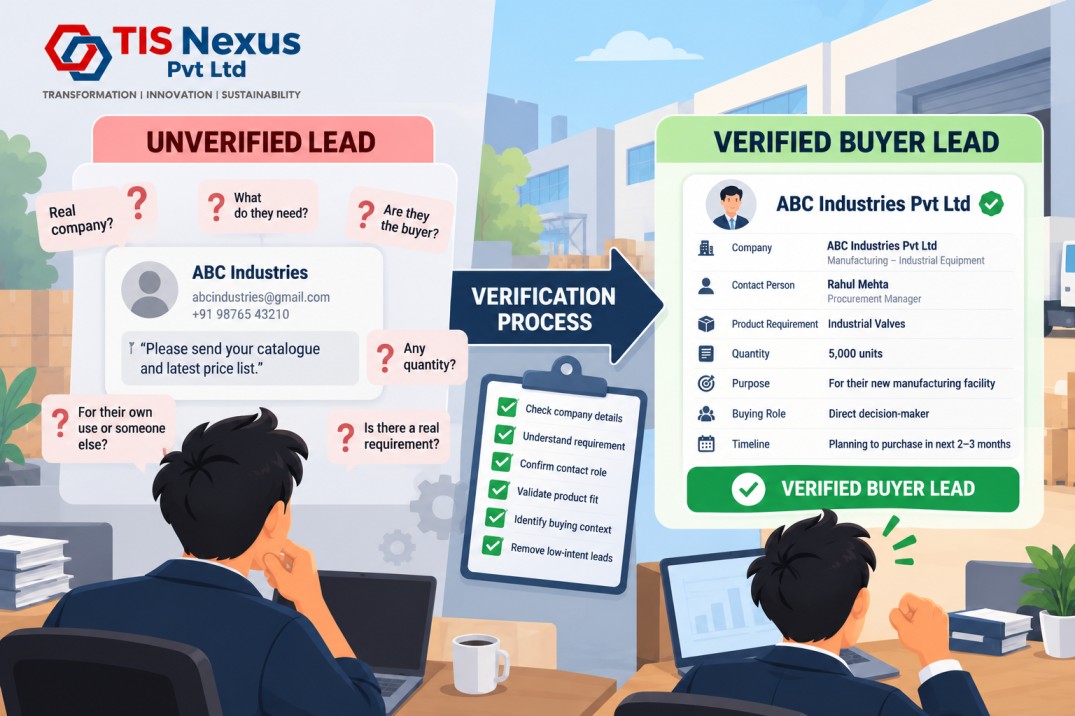
A verified lead is still a lead
The first mistake is expecting too much from the word “verified.”
Verification does not turn a prospect into a confirmed customer. A company can be genuine, the contact can be correct and the requirement can be real, yet the purchase may still be delayed or cancelled.
A manufacturer might speak with a procurement manager who is sourcing suppliers for a project that has not received final approval. The person is real, the company is real, and the requirement exists. The order simply has not reached the point where someone can place it.
That would still be a verified buyer lead.
The sales process has to take over from there.
What exactly should be checked?
There is no single field that proves a lead is genuine.
The company needs to be real and relevant to the product being offered. The contact should actually belong to the company. Their role should have some connection to the enquiry, or they should be able to direct the salesperson to the person handling it.
Then there is the reason for the enquiry.
A company asking about industrial equipment because it is preparing for a new project gives sales something concrete to work with. A person asking for a complete catalogue without being able to explain why they need it gives much less information.
Neither situation automatically makes the lead good or bad. They are simply at different stages.
The company behind the contact matters
Manufacturers sometimes focus so heavily on the individual contact that the business itself gets little attention.
That can create strange leads.
A company may be genuine, but its business activity has no connection to the product. Another may operate in the right industry but only purchase through distributors. A third may be a trader that buys for other customers.
All three are real businesses.
The sales team needs to know which type of company it is dealing with before assuming that the enquiry represents direct demand.
A basic company check can help answer that. What does the business do? What products does it deal in? Does the company's activity give it a sensible reason to purchase from this manufacturer?
The purpose is not to predict whether an order will happen. It is simply to establish why the company belongs in the pipeline.
The contact should have a believable role
A verified buyer lead should not rely entirely on a job title.
Someone listed as a purchase manager may genuinely handle procurement. Another person with a technical title might be responsible for selecting the specification before procurement gets involved. A founder may personally manage buying for a smaller business.
There are also plenty of situations where the person who first responds is not the person who places the order.
That is normal.
The useful question is whether the contact has some relationship to the purchase. If they say that procurement handles the order and provide the correct person's details, the lead can continue moving through the sales process.
What creates trouble is discovering that the person has no idea why the manufacturer is calling and has never been involved with the product in question.
A real enquiry should have some reason behind it
This is probably the most useful part of verification.
Why did the company contact the manufacturer?
Maybe an existing supplier cannot meet the requirement. Perhaps the business has started a new project. It could be reviewing suppliers for an upcoming purchase or looking for a particular specification that its current source does not provide.
The explanation does not need to sound impressive.
A buyer saying, “We need this for a new production line” gives sales a starting point. So does a procurement employee explaining that the company is gathering quotations for a planned purchase.
On the other hand, “We just wanted your catalogue” leaves the purpose of the enquiry unclear.
That does not mean the second contact should be rejected. It simply means sales should know that it may be an information request rather than an active purchasing opportunity.
Direct buyers are not the only valid buyers
The word “buyer” can create another misunderstanding.
A distributor or trader may purchase products regularly and resell them to other businesses. A sourcing company may be responsible for arranging purchases for its customers. These contacts are not necessarily end users, yet they can still be genuine buyers.
Verification should make their role clear.
If a contact says that the product is being sourced for a customer, that is useful information. The manufacturer now knows that another company is involved. The purchase may depend on that customer's approval, and the person on the call may be managing the sourcing process rather than making the final decision.
There is nothing inherently wrong with that arrangement.
The problem would be recording the contact as a direct buyer without understanding the relationship.
Product details can expose weak verification
A manufacturer should also look at what the person is actually asking for.
A lead requesting one specific product with a clear specification usually gives sales more to investigate. A buyer may know the quantity, application or required model. The details can change later, but there is already a real commercial question.
A vague request covering a large product range tells you much less.
Sometimes procurement is genuinely exploring options, so broad enquiries are expected. What matters is whether the contact can gradually provide more information when the salesperson asks sensible questions.
If the person cannot explain what the product will be used for, who needs it or why the company is considering it, the lead may still be worth keeping, but its status should be understood.
Verification should happen before sales invests time
There is a practical reason manufacturers care about all this.
Salespeople have limited time. If every lead requires several calls just to discover whether the company is relevant, the sales team ends up doing basic research instead of having actual sales conversations.
A verified lead should remove some of that work.
The salesperson should have enough information to know who the company is, who the contact is and why the conversation exists. There will still be questions once the call starts. That is unavoidable.
The difference is between beginning with a reasonable picture of the account and beginning with nothing more than a name and phone number.
Old leads need to be treated carefully
Verification is not permanent.
Employees leave companies. Businesses change direction. Projects get cancelled. Procurement requirements disappear. A phone number that worked when a contact was added to a database may now belong to someone else.
This becomes especially important when manufacturers return to older B2B lead lists.
A lead may have been completely accurate when it was collected and still be useless today. That does not necessarily mean the original verification was poor. It means business information changes.
Before reviving old leads, it makes sense to check whether the company and contact details are still current and whether there is any reason to believe the requirement remains relevant.
Verification is different from qualification
These two terms often get mixed together.
Verification asks whether the lead is genuine.
Qualification asks what kind of sales opportunity it represents.
A verified contact can have no immediate requirement. Another verified buyer can be actively collecting quotations. Someone else may have a real need but still require approval from another department.
Those are all different sales situations.
The mistake is expecting verification to answer every question the sales team will eventually have. It cannot. Its job is narrower: establish that the lead itself is credible enough for sales to spend time on it.
A salesperson should not have to discover everything from scratch
The quality of a verified lead becomes obvious when the sales team opens the record.
Imagine seeing only this:
Company: ABC Industries
Contact: Raj
Interest: Products
There is almost nothing to work with.
Now imagine the same record contains the company activity, the contact's role, the relevant product category and a note that the company is currently looking for suppliers for an upcoming requirement.
The second lead may not be any closer to an order, but the salesperson can begin the conversation with some understanding of why the company is being contacted.
That context is a large part of what makes verification useful.
Good buyer sourcing leaves some context behind
For manufacturers, buyer sourcing should not stop at finding a company's contact information.
The sales team eventually needs to understand the company it is approaching. Who is the contact? What does the business do? Why could the product be relevant? Is the person involved in purchasing, or is somebody else responsible?
These questions do not require a huge research document. They simply need to be answered well enough that the salesperson knows what they are calling about.
This is where TIS Nexus fits into the broader B2B buyer sourcing process. The purpose of sourcing is not just to increase the number of contacts entering a database. The information needs to be useful when it reaches the people responsible for sales.
A verified lead can still require research during the sales process. It can still go cold. It can still be rejected. It can even turn out to be the wrong opportunity after a proper conversation.
Verification simply gives the salesperson a more reliable starting point.
“Verified” should have a practical meaning
For a manufacturer, the word should mean something more specific than “we found a phone number.”
The business should be real. Its activity should make sense for the product. The contact should belong to the company and have some connection to the enquiry. There should be a believable reason why the conversation started, even when the purchase is still some distance away.
If another company is involved, that should be clear too.
None of this promises that the prospect will buy. Some verified leads will be delayed, some will disappear and some will simply decide not to proceed.
That is normal.
What verification gives a manufacturer is a cleaner starting point. When the sales team picks up the phone, it should have a reasonable answer to one basic question:
Why is this person worth calling?
For businesses looking to build that kind of pipeline, TIS Nexus provides a place to explore B2B buyer sourcing.