A Kanpur Buyer and a Bad Spreadsheet
Last winter a trader from Kanpur sent me his costing sheet and asked why his margin kept vanishing. Two lines. Bamboo sticks and fragrance oil. Everything else was missing. No charcoal powder, no jigat, no packing film, nothing for the 8 percent or so of sticks that snapped in the drying room.
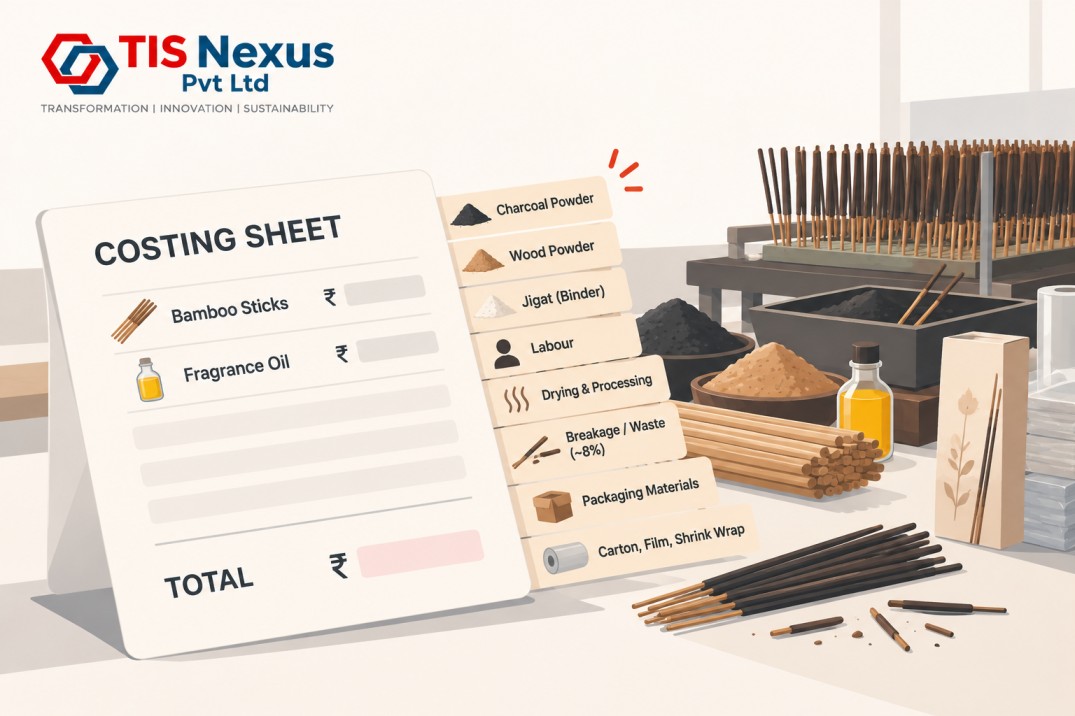
He'd been quoting agarbatti manufacturing cost off a supplier's rate list for six months. Selling at a loss on every carton and thinking it was the market.
I went through it with him line by line, and honestly the sheet wasn't stupid. It was just a sheet written by someone who had never stood next to a rolling table in July.
Where the Money Goes in the Raw Material
Bamboo sticks are the part everyone sees first. Round sticks, 8 inch, 9 inch, the price moves with the monsoon because wet bamboo rots before it ever reaches a rolling unit. We stopped buying in bulk before July after one lot came in with mould spots on maybe a fifth of the bundles.
Then the masala. Charcoal dust and wood powder carry most of the weight, and the cheap grades are where I've seen buyers get burned. A powder that looks fine in the bag burns with a sooty edge, and a customer in Jaipur sent back a whole batch for exactly that.
Jigat is a small line on paper. A few rupees per kilo adds up when you're rolling by the quintal, and a bad binder makes sticks crumble at the base.
Fragrance is the big swing. Sandalwood-type oils can cost ten times a floral blend, and the agarbatti raw material price list you got last quarter is probably wrong by now. I check it monthly. Not weekly, I'm not that disciplined.
The Losses Nobody Writes Down
Take a day I remember from a unit near Aligarh. They rolled something like 300 kilos of wet sticks and dried them on open racks. Rain came in at about 4 pm. By morning the bottom racks had warped and a chunk of the sticks were bent past saving. Call it 25 kilos gone, and that was one afternoon.
Breakage and rejects eat into incense stick making cost every week, and a sheet that assumes zero waste is fiction. I add a loss figure to every costing I do. Somewhere in the 5 to 10 percent range depending on season, higher in the wet months.
Dipping adds its own mess. Oil soaks into the stick, but some stays in the tray and some evaporates, so you never get 100 percent of what you bought onto the product. Probably closer to nine-tenths in a good week.
One Job, Start to Finish
A buyer in Lucknow wanted a mid-range sandalwood-type stick, packed in 20-stick boxes, sold in cartons of 144 boxes. He came to us after two other quotes that looked cheap and then weren't.
We started with the sticks and masala, which came to a reasonable base. Fragrance was the argument. He wanted a stronger throw than the sample, which meant more oil per kilo, which pushed his cost up by a few rupees a box. He grumbled. I told him the cheaper oil he'd used before was why his old customers stopped reordering, and he went quiet.
Packing surprised him most. Printed box, shrink wrap, inner tray, carton, tape. He had budgeted for the box and forgotten the rest. By the time labour, drying, and the loss allowance went in, the unit cost sat about 30 percent above his first guess. Roughly. I don't have the exact sheet in front of me.
He signed anyway. Reordered in six weeks.
If you want to see how a finished range looks before you cost your own, the Aromatic Incense Sticks Manufacturers, Dhoop & Agarbatti Wholesale | TIS Nexus page shows the types we make and pack.
What Dhoop Does to the Math
Dhoop is a different animal. No bamboo, so one big line disappears. But the base is heavier, with more resin, more aromatic powder, and a lot more fragrance per piece.
A trader in Varanasi switched from sticks to cones thinking dhoop manufacturing cost would be lower. It was lower on materials. It was higher on moulding time, because cones need to set and dry slowly or they crack. He lost most of a week's output to cracking in his first month and nearly gave up.
Cups and sambrani blocks are different again. I won't go into those, the margins vary too much by region.
The Mistake I See Most Often
Buyers compare per-kilo rates. A supplier says 180 a kilo, another says 210, and the cheaper one wins. Every time.
Except a kilo of sticks isn't a kilo of anything useful. Stick count per kilo changes with thickness and length, and the thin ones can give you a third more pieces. I've watched a buyer pick the 180 quote, count the sticks, and discover he was paying more per box than at 210.
Count the sticks. Weigh a sample. Do that before you argue about price, and honestly before you talk to anyone's sales team, mine included.
Fixing the Sheet
The Kanpur trader rebuilt his costing in an afternoon. We added the missing lines, set a loss figure of 8 percent, and moved his quote up by a few rupees a box. He lost one customer over it and kept the other four.
Packing film, by the way, doubled in price last year for about two months and then fell back. If you're sizing a first order, our incense and dhoop range is a fair place to compare actual unit weights before you commit to anything.
The Kanpur sheet is still on my laptop. Sixteen rows now.