A Hundred and Fifty Rupees in Haridwar
Winter of 2021, a stall just off the main ghat, and I was supposed to be buying for a client's shop. Twelve malas, five-mukhi, all the same brown. The owner had a sing-song way of saying "original, original" that I should have taken as a warning.
I bought one bead. A hundred and fifty rupees, which he thought was funny.
The mechanic next door let me clamp it in his vice and gave me a file, and he stood there chewing something while I worked. It took a minute or so. The cut face came out grey and chalky with a tiny air bubble sitting near the edge. Nothing like a seed. I walked back, set the bead on his tray and said nothing. He looked at it, looked at me, and started talking about the weather.
That bead is why I answer slowly when someone asks me how to verify rudraksha. Everything below came after it.
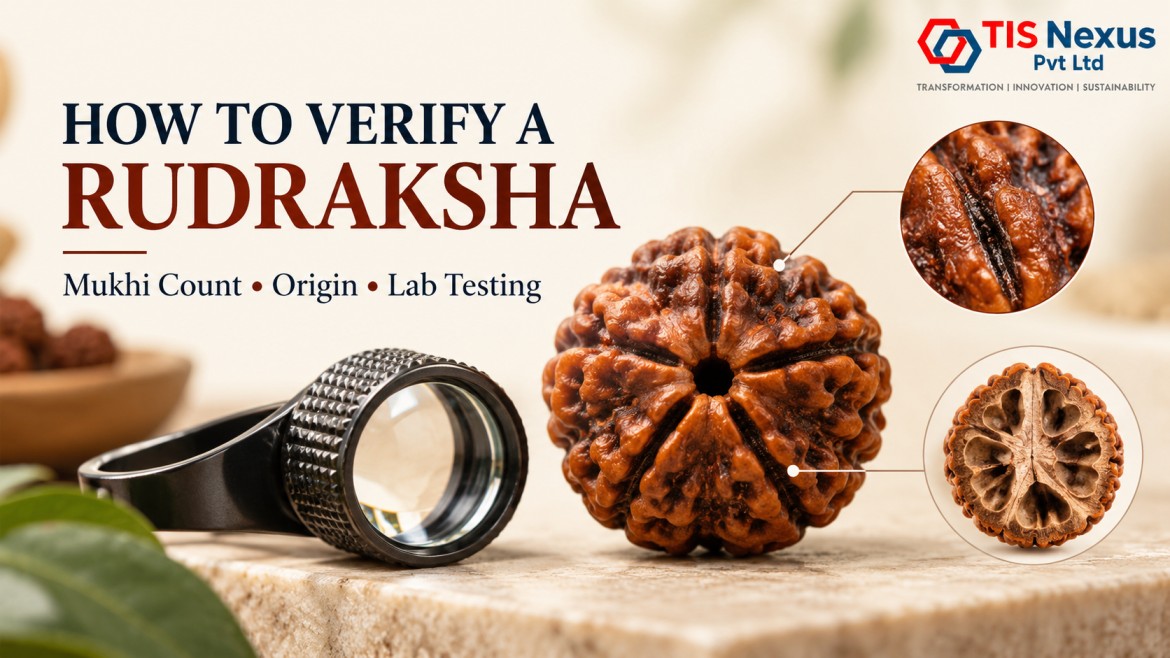
Counting the Mukhi Yourself
A jeweller in Jaipur once sent a client a batch tagged seven-mukhi. Seven was what pushed the price up, of course. The client had a loupe from a stationery shop, nothing fancy, and under it three of the seven lines gave up halfway down and never touched the base. Surface scratches.
I've held a six-mukhi where two grooves ran so close together that I counted five the first time through. Grooves on a real bead wander. They go from the top hole to the bottom hole, and the gaps between them are never quite equal.
Cut lines have a look once you've seen enough of them. The lip is sharp, and the colour down in the groove runs paler, almost raw, as if nobody had ever touched it. Which nobody had. An old groove goes soft at the edge and carries the same shade to the bottom, darkened by hand oil over years.
The Fourteen-Mukhi Quote
Kanpur, a couple of Diwalis back. A client got a fourteen-mukhi price so low it wouldn't have paid the courier on a genuine one, and he took two anyway. Optimist, that man. Both turned out to be plain five-mukhi beads with extra lines scraped in with something sharp. When he drove back to the market, the shutter was down and a padlock was hanging off it.
Past ten mukhi I get twitchy before the seller has finished his sentence. I'd rather lose the sale.
A Cheap One-Mukhi at a March Fair
Three stalls within fifty metres of each other all had one-mukhi beads. Prices were a few hundred rupees apart. A woman I know wanted one for her uncle's birthday, and I told her a piece like that doesn't turn up three times on a single lane. She bought it anyway.
She had it scanned a week later, mostly to prove me wrong. Five-mukhi, with four lines sanded off, and the sanded patches showed up as flat, slightly shiny spots near the base. She didn't speak to me for a few days. Then she asked to borrow my loupe.
Where the Bead Grew and What It Costs
A trader I know paid something like double for a mala sold as Himalayan. Small, polished, tight grain, obviously island stock. Good beads, honestly. Wrong invoice.
The hill ones usually come bigger and rougher with deep pits between the grooves, while island beads run smaller and smoother. Plenty of regular wearers prefer those. Nobody is cheated by either kind unless one gets billed as the other.
Around 2019 I stopped listening to origin claims said out loud. These days I ask for the packing slip first, then the invoice, then which port the lot came through and roughly when. A seller with real stock answers before I finish asking. The other kind starts on his grandfather's shop.
Last month someone offered me a twelve-millimetre bead at a bargain rate and I actually laughed. Something that size has to be dug out and hauled down, and that money has to come from somewhere.
Gift Malas for a Lucknow Wedding
Two hundred small malas for wedding return gifts. The boutique owner wanted every one of them five-mukhi, and she'd asked her supplier for a rudraksha authenticity certificate with each batch. The paperwork reached her by courier that same week. Good print, a round stamp, a lab name running across the top.
She rang me because she couldn't find that lab anywhere online. We went through the sheet together. No bead weight, no date, no measurements. "Certified original" in a curly font, which made me wince a little.
She asked the supplier for a phone number for the lab. Three days of nothing, then he offered ten percent off. She cancelled the order. Her friend had bought from him a month earlier and dropped the beads in a bowl of water, where they floated for about a minute before going down. Soaked wood, dyed dark.
I don't lean on the water trick myself. Some real seeds sink straight away and some old ones hover. Fine for a glance at the stall. Worthless as proof.
The Original Rudraksha Test in a Lab
A client in Delhi got nervous after paying a good amount and sent two beads to a lab. The report took about a week. One bead came back clean. The other showed four chambers on the scan, which made it a four-mukhi with a fifth line cut into the shell, and she'd been sold it as a five.
Carvers can't touch that part. Every honest bead I've seen scanned had one chamber behind each line. A solid grey core with nothing inside, and I've watched a few of those come through, was either cast or a piece of dyed wood. Her report gave the weight, the size, a date and a number the lab confirmed when she called. The fee was small next to what the beads had cost her.
She took the sheet to the shop herself. The seller took the bead back without much of a sigh, since the paper had already finished the argument. I've never seen a seller fight an original rudraksha test once it was lying on the counter.
Calling the Lab Before Trusting the Paper
Printing a certificate needs a laptop and ten minutes. The few I keep in a folder had a real lab address and a landline that somebody picked up, and the person who answered read the report number back to me. I did that call from the shop doorway once, with the seller watching.
If a seller won't let me ring, I leave. No second round of chai.
Decorative Strands Sold as Devotional
Some of the fakes I've traced were never meant to be sacred at all. Somebody bought cheap decorative strands for a photo shoot, and a few resales later the same strand had a devotional label and a devotional price.
Costume pieces and shop-window props are a separate business, and a decent one. When a client asks me for that kind of order, I send them to artificial jewellery suppliers who write the material in the listing. Paying a devotional price for a dressed-up strand is the part I can't stand.
Bulk Buying and the Top-Layer Trick
Retail customers get fooled by one bead. Wholesale buyers get fooled by the carton.
A man in Mumbai ordered two thousand beads for resale. He tested ten from the top of the box, all ten passed, and he signed. The supplier had put good stock on the first layer and filled everything under it with a lower grade. About four hundred malas came back over the next two months from temples and gift shops, and he ate the loss.
Ten extra minutes on samples from the middle and bottom of each carton would have saved him. I take my own loupe to bulk deals now, plus a small knife I don't mind ruining on a couple of beads per carton. Honest sellers watch and chat about the traffic. The others suddenly need lunch.
What My Hands Check First
Rolling the bead between my fingers comes before anything else. Real seeds have a grain to them and the pits never match each other. Machine copies feel slick, a bit greasy, and I notice that before I notice anything visual.
Then the drill hole. On one natural bead I bought, the inside was darker than the outside but the texture ran straight through. The fakes I've handled had paler, cleaner holes, probably because the shell was painted after the drilling.
A packet I opened in a small Agra shop last winter made the whole counter smell like a paint store. Genuine seeds smell faintly of wood and earth, at least the ones I've held.
Weight goes last. Foam or hollow resin feels light for its size, and that bead goes back on the tray.
Before You Pay
A seller who knows the product will let me cut one bead and call the lab. For decorative strands sold honestly as imitation, the imitation jewellery range at TIS Nexus is where I'd point a shop owner first. For the real thing, the lab report comes before the price.
I'd still cut one bead and look inside before buying a hundred.