The Tank That Ran Dry by Two in the Afternoon
A dyeing unit near Tirupur bought a 2,000 LPH plant because the owner's brother-in-law called it plenty for a factory that size. It ran fine for two weeks. Then the dyeing line went to full shifts and the permeate tank was empty by two every afternoon. The operators began topping up with raw water, quietly, and the owner found out when a batch came back rejected.
Calls about how to choose RO plant capacity often start with a story like that, or with a number a neighbour used. I've heard "2,000" more times than I can count. It usually came from someone else's plant, someone else's water, and it gets carried over to a site where neither applies.
How to Choose RO Plant Capacity Without Trusting the Nameplate
A plate saying 1,000 LPH was earned on a test bench with a clean membrane and a feed water picked to flatter it. A site in Gujarat in May feeds the same plant water that's ten degrees warmer than a Punjab site gets in January, and membrane output follows temperature by a couple of percent for every degree, give or take. So identical machines look like a hero in one place and a disappointment in the other.
New membranes on soft borewell water beat their plate figure easily. Two years in, on hard feed with high TDS, the same membranes get nowhere near it. When I look at a plate figure I read it as the best day the plant will ever have.
A site manager in Rajasthan once swore his plant had lost a chunk of its output after a year, and he was ready to blame the manufacturer. The membranes were fine. His feed had moved from a winter reading to a summer one and nobody had told him that temperature alone shifts the number. A cleaning cycle and some patience got most of it back.
An RO Plant LPH Calculation on a Real Job
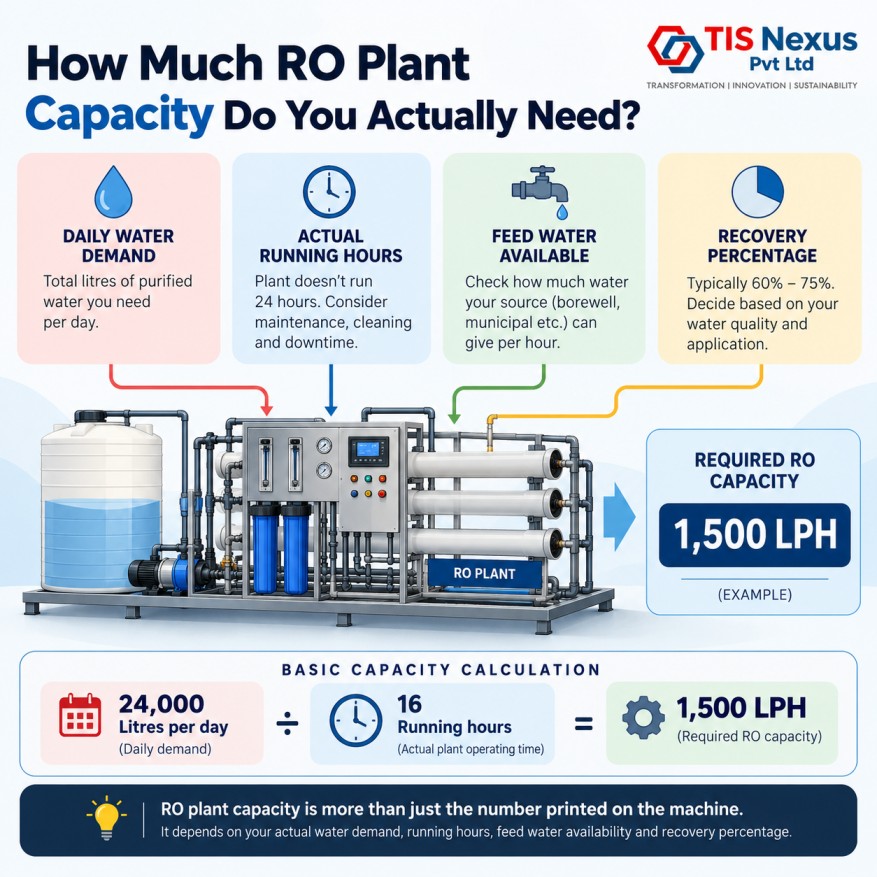
A pharma client came to us wanting 24,000 litres a day. His own first working was 1,000 LPH, since 24,000 over 24 hours gives exactly that, which is the sum most people do first. The plant doesn't run 24 hours though. It goes down for flushing, for cleaning, for the odd membrane check. He actually planned on sixteen running hours, and that took the figure to 1,500 LPH before we'd touched anything else. We rounded up a bit.
Feed came next. At 70 percent recovery roughly three litres in ten go to reject, so to make those 1,500 litres of permeate he needed something like 2,100 litres an hour coming in. His borewell gave 1,800. We spent the next hour talking about a second source and a bigger raw water tank, which he hadn't planned on at all.
Daily Volume Hides the Peak
Between six and eight in the morning, a food plant we worked with pulled something like 3,000 litres for CIP and batching, then very little until the afternoon. Sized to the daily average, it would have run dry every morning around seven.
Two ways out, and they cost differently. A bigger plant that takes the peak head on needs more membranes and a bigger pump, plus a power bill that runs through hours when nobody needs the water. The other way is a smaller plant with a properly sized permeate tank behind it, and the tank soaks up the spike. I'd take the tank nearly every time. Tank volume is cheap and plant capacity isn't, and a plant held at one steady flow lasts longer than one forever ramping up and down.
As a rough habit I look at the thirsty two hours, size the tank to cover most of that draw, and let the plant refill it through the quiet part of the day. Owners don't love hearing it, since a tank takes floor space and the plant takes the headlines, but floor space is easier to find than money for a bigger skid. The food plant ended up with a mid-sized skid and a tank holding about the morning's draw, and the line stopped waiting.
One Bottling Unit, Two Borewells
A packaged water unit in western UP wanted 5,000 LPH. They had the orders to justify it. What they had less of was water: two borewells, one giving around 4,000 litres an hour in good months and noticeably less before the monsoon, the second around 2,000, with a TDS near 1,800 on the weaker one.
At 60 percent recovery, 5,000 LPH of permeate wants over 8,000 litres of feed every hour. Together the two wells came nowhere near that in any month. The plant would have run in bursts and tripped on low inlet pressure, and the membranes would have scaled from all the stopping and starting. The owner had half agreed a price on the bigger machine and took it badly when we said so.
We sized it at 3,000 LPH with a larger raw water tank and a staged recovery layout, which is the sort of configuration you'll find across the range ofcommercial and industrial RO plants we build. He grumbled about it for a month. Then the dry season came, and his plant kept filling bottles while a competitor two villages over stood idle waiting for his own borewell to recover.
Water Treatment Capacity Sizing and the Margin Everyone Adds
The consultant adds twenty percent for safety. The plant manager adds twenty on top of that, and the vendor adds a little more so there's no complaint later. By the time the order goes out, the plant is close to double what the process draws. It then runs at part load. The membranes sit in standing water between short runs, and fouling turns up early.
Buyers treat oversizing as the safe error. I've watched it chew through a set of membranes well ahead of schedule, and there's a reason I'm blunt about it: a plant bought at twice the size spends most of its life doing nothing, and you're paying for pumps and membranes that sit there waiting. For margin, fifteen to twenty percent over peak demand sounds reasonable to me, decided once and written down with a reason beside it.
Leaving Room to Grow
A garment washing unit told us they'd double output within three years. We didn't sell them the double plant. We built the skid with one membrane housing left empty and a valved connection waiting beside it. They bought the extra membranes in year two, for a fraction of what the larger plant would have cost on day one, and spent the difference on raw water storage.
Pre-Treatment Takes Hours Away
A laminate maker in Gujarat had a plant sold as 1,500 LPH that was delivering nearer 1,300 on a normal day. Nothing was wrong with the membranes. The sand filter backwashes daily and the softener regenerates on its own schedule, and each of those pulls the plant offline for a stretch. On paper he had sixteen running hours and in practice something closer to fourteen, which nobody had put into the calculation.
Another unit I visited ran its carbon filters well past the change date because the pressure drop looked fine. The permeate tasted off by the third month. It cost them a membrane clean and some embarrassment in front of a customer, and the filter change that would have prevented it cost very little.
Iron is the first thing I test for. A borewell carrying even a little dissolved iron fouls a membrane faster than high TDS does, and extra capacity does nothing for a membrane that's already coated. The TDS pen reading buyers send me from the tap tells me very little. I want a full lab analysis with iron and hardness before I'll put a number on a quote.
What to Send a Manufacturer Before the Quote
A supplier can't quote properly without your daily demand and the peak hour. Feed TDS comes next, along with how much the source really gives per hour in the dry months. Run hours too, if you know them. With that in hand a quote means something, and without it you're comparing guesses.
When we put a quote together atTIS Nexus, most of the first call is questions about the feed water, and I'd be wary of any supplier who quotes before asking about it. I'd also ask for the design basis in writing. A permeate figure worked out at 25 degrees reads differently when your summer feed sits at 35, and some quotes never mention the temperature at all.
Before You Sign
When I compare quotes from differentRO plant manufacturers in India, I hold each one against the worst week of water use the site has had. I also go and ask the operator on the 6 am shift how many times he refilled the tank last month. He knows the real draw better than any drawing does.