A contact is not automatically a lead.
That distinction sounds obvious until a fresh list lands in the CRM.
There are names. Job titles. Company names. Email addresses. Phone numbers. Maybe even LinkedIn profiles and company details.
It looks like progress.
Then sales starts calling.
One person isn't involved in purchasing. Another works in the wrong industry. Someone else has no current requirement. A few contacts say they never asked for anything in the first place.
Suddenly, the list has a very different value.
This is the awkward part of B2B lead generation services. Collecting contact data is relatively straightforward. Creating a list that sales can actually use takes much more work.
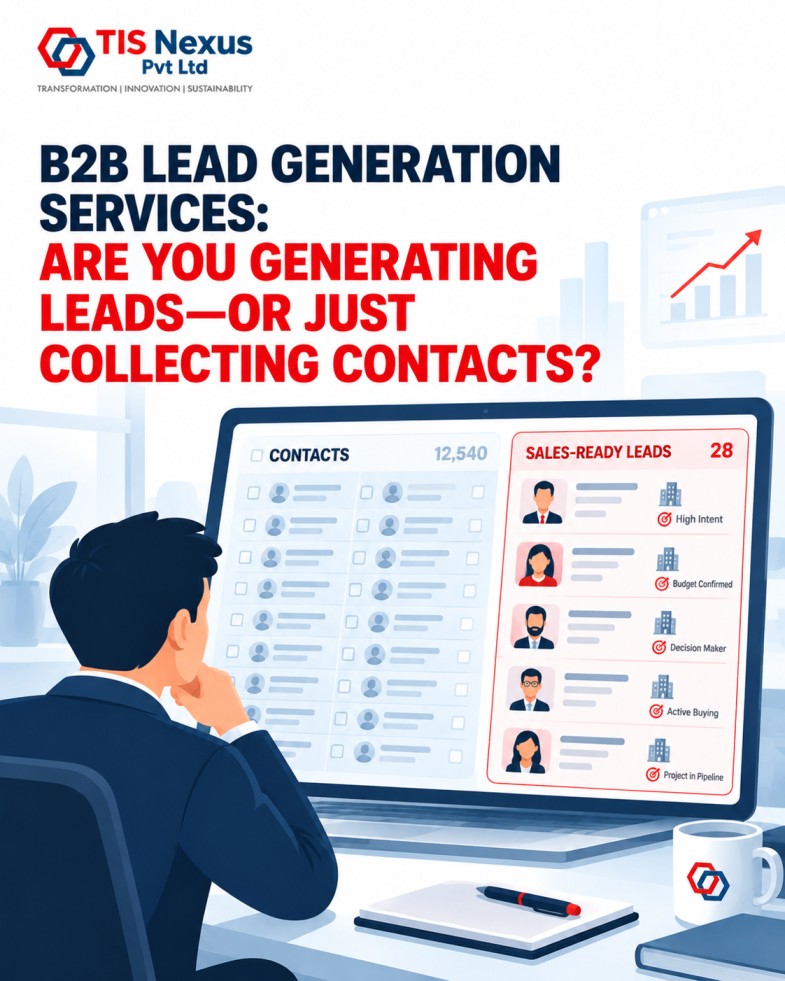
A contact database can look impressive
Numbers have a way of making things look better than they are.
A team adds 1,000 new contacts and the monthly report shows 1,000 leads.
But were they leads?
Maybe 150 companies fit the target market. Perhaps 70 contacts have a relevant role. A smaller group has some reason to have a conversation.
The original number wasn't false.
It just wasn't telling the whole story.
Good lead generation isn't really about making the database bigger. It's about making the database more useful.
A sales rep would usually rather open a list and immediately understand why each company is there than spend half the morning figuring it out.
The company has to make sense first
A lot of lead sourcing starts with people.
It should start with businesses.
Who is actually a fit for the product or service? Which industries make sense? What kind of companies are worth approaching? Are there certain locations, business sizes or operating models that matter?
Those questions narrow the field.
And that's useful.
A perfectly verified contact from the wrong company is still the wrong contact.
This is one of the quieter parts of qualified B2B leads. Qualification starts before the name enters the CRM.
Then comes the person
The right company doesn't guarantee the right contact.
A person might work in the right department but have no role in the buying decision. Someone senior may influence the discussion without handling procurement. Another employee may simply be doing research for a manager.
None of this makes the person useless.
It just means the lead needs context.
Sometimes a good contact is the person who can introduce the salesperson to the actual decision-maker. Sometimes they're the one who understands the requirement better than anyone else.
The important thing is not to confuse job title with buying authority.
“Verified” is not the same as “qualified”
This deserves its own point.
An email can be valid.
A phone number can be active.
The company website can be correct.
The person can genuinely work there.
And the lead can still be terrible for sales.
Verification answers a data question.
Qualification answers a business question.
Does this company fit?
Is this contact relevant?
Is there a reason to start a conversation?
Those are different checks.
A strong B2B lead generation process needs both.
The reason behind the enquiry matters
There's a big difference between a person saying, “Send some information,” and someone saying, “We're looking for this service for an upcoming project.”
Both may enter the CRM as leads.
One has context.
The other has very little.
That context doesn't need to be a long paragraph. Even a short note about the requirement, the project, the timing or the department involved can change the quality of the handoff to sales.
Without it, the salesperson starts from zero.
And nobody enjoys starting from zero.
Some good leads aren't ready yet
This is where lead qualification can get too rigid.
A company can be a strong fit and still not be buying right now.
Maybe the requirement is planned for later. Maybe the budget is waiting for approval. Maybe the current supplier contract hasn't ended.
Calling that a bad lead doesn't really help.
It may simply be early.
There's a difference between “not relevant” and “not yet.”
A sensible lead generation process keeps that difference visible instead of throwing both into the same rejected bucket.
Timing is part of B2B lead quality.
Sales usually finds the cracks quickly
Reports can look great until the sales team gets involved.
That's when patterns start appearing.
The same job titles keep showing up.
The same type of company gets rejected.
Certain enquiries never contain a real requirement.
Other companies look promising, but nobody knows who the right contact is.
Sales feedback is useful information, not just an opinion about the list.
If ten sales reps keep rejecting the same kind of lead, there is probably something worth fixing upstream.
Maybe the audience is too broad.
Maybe the contact targeting is off.
Maybe the qualification criteria aren't strict enough.
The answer depends on what the rejection actually says.
A sales rep shouldn't have to investigate every record
Imagine receiving a lead with nothing except:
Name.
Company.
Email.
Phone.
That's not useless. It's just incomplete.
The salesperson now has to research the company, work out what it does, guess why the contact might matter and figure out where the conversation should begin.
That research can take longer than the actual first call.
Good B2B lead generation services should reduce that uncertainty.
The record doesn't need twenty fields and a giant biography.
It needs useful information.
Enough to answer the basic question: why is this person worth speaking to?
Lead volume is an easy number
This is why it appears everywhere.
It's easy to count.
Lead quality is harder.
To understand it, the reporting has to follow what happens after the lead is created.
How many were relevant?
How many were accepted by sales?
How many resulted in an actual conversation?
How many had a genuine business requirement?
Which ones moved into the pipeline?
Those numbers don't always make the report look prettier.
They do make it more honest.
A smaller list with useful conversations behind it can tell a very different story from a huge list that sales spends its time cleaning.
Buyer intent doesn't always arrive in a form
A lot of intent shows up during the conversation.
The prospect explains a problem.
They mention an upcoming project.
They ask about a specific requirement.
They want to know how the service fits their current setup.
They ask what happens next.
Those are useful signals.
Someone downloading a general document and disappearing has given a much weaker signal than someone explaining exactly what their company needs.
This is why B2B buyer intent can't really be reduced to a single field in the CRM.
The conversation matters.
The source of the lead isn't enough either
A business can get leads through search, referrals, direct outreach, existing relationships or other channels.
That's worth tracking.
But the source doesn't tell you whether the lead is commercially useful.
A source can produce a huge number of contacts and very few real conversations.
Another may produce fewer contacts but stronger opportunities.
The interesting part is what happens after the lead arrives.
That is where B2B lead generation services should be judged.
Not only by how many records they produce, but by how usable those records are for the sales team.
TIS Nexus works around this earlier stage
TIS Nexus(https://tisnx.com/) fits into the earlier part of the process, where relevant businesses and contacts need to be identified before sales starts spending time on them.
The difference is important.
A database can answer, “Who can we contact?”
A useful lead generation process should get closer to, “Who is worth contacting, and why?”
Company fit matters.
Contact relevance matters.
Context matters.
None of those guarantee a sale, and they don't need to. The job is to make the starting point stronger.
The CRM should tell a small story
A useful record should make sense when someone opens it.
Why was this company selected?
Why this contact?
What is the likely requirement?
Has anyone spoken to them?
Is the timing immediate or later?
What happened in the last conversation?
That context makes a sales team's work easier.
Without it, every new lead becomes another research task.
And after a while, a company can end up paying for lead generation while its salespeople are still doing the lead generation themselves.
That's usually a sign that something got lost between sourcing and qualification.
Collecting contacts isn't the hard part
The hard part is making those contacts useful.
That means starting with the right companies, finding people who have some connection to the buying process, checking the business context and giving sales enough information to begin a proper conversation.
Some leads will be ready now.
Some will be ready later.
Some will never be relevant.
That's normal.
The important thing is knowing which is which.
TIS Nexus approaches B2B buyer generation with that earlier distinction in mind. The goal isn't simply to keep adding names to a spreadsheet.
Because a spreadsheet can be full while the pipeline is empty.
A contact is data.
A lead has a reason.
Sales can work with the second one.