A Pump Maker in Coimbatore Who Got Zero Replies
Eleven months ago I sat with the sales head of a mid-size pump manufacturer. He had 3,800 connections and a company page nobody opened. His team had sent something like 600 connection requests that quarter, each followed by the same brochure message. Two replies. One was a vendor selling him software.
He blamed LinkedIn. I looked at the messages and blamed the messages.
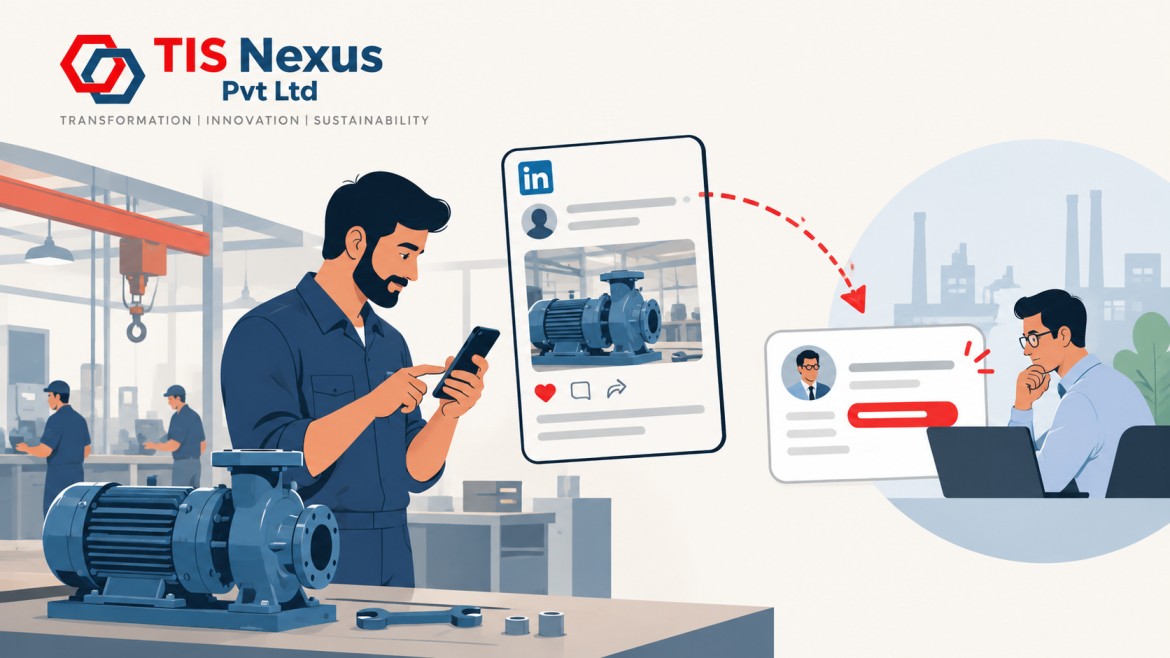
Why LinkedIn Lead Generation in India Works Differently on the Factory Side
Indian buyers on LinkedIn are mostly purchase managers, plant heads and the odd director who still checks his phone at 7 in the morning. They don’t scroll for fun. They scroll between a supplier call and a shift handover, and anything that looks like a pitch gets swiped away in about a second.
A forging unit near Pune told me their best enquiry last year came from a single post. It was a photo of a rejected batch, with two lines about what went wrong in the heat treatment. A procurement lead at an auto ancillary replied under it. He wasn’t looking for a vendor that day. Three weeks later he asked for a quote.
That’s the pattern I keep seeing. People buy from the plant that looks like it knows its own mistakes.
The Company Page Most Manufacturers Build
Logo, tagline, a certificate image, a link to the website. Done in an afternoon, then abandoned.
I’d say this is where most budgets quietly die. Nobody visits a page that never changes. A cable manufacturer in Gujarat posted once in four months, and it was a Diwali greeting. Their page had more followers than their rival’s, nearly double, and the rival still got the calls.
The page matters less than the people behind it. A works manager posting from the shop floor gets read. A page posting a stock graphic of a handshake doesn’t.
What the Founder’s Profile Does That the Page Can’t
Founders and plant heads carry trust in a way a logo can’t. One owner of a small fabrication shop in Rajkot started writing three lines a week about jobs that went sideways. A late delivery, a drawing revision that arrived after cutting had begun. His inquiries went from almost none to maybe four or five a month, though he’d never admit it was the posting. He thought it was luck.
Targeting Buyers Without Spamming Them
We tried a broad approach for a packaging machinery client first. Every procurement title in Maharashtra, one template, one follow-up. It flopped.
Then we narrowed to plant heads at food processing units, maybe 120 people in total, and wrote each opening note by hand, referencing something on their own page or their plant’s product line. Replies came from about one in seven. Slow, tedious work. Also the only version that produced a quote request.
I’d rather send forty good messages than four hundred lazy ones. Sales teams hate hearing this because the numbers on a dashboard look smaller.
Content That Brought Actual Enquiries
Specs don’t travel well on this platform. A datasheet pasted as a post gets maybe a dozen impressions from your own staff.
What did work, repeatedly, was the story of a job. A textile machinery spares supplier in Ludhiana wrote about a customer who kept ordering the wrong bearing size because the old drawing was wrong, and how they fixed the drawing instead of just shipping the right part. Buyers in the comments started tagging colleagues. Someone from a spinning mill asked if they could check their own drawings the same way.
Photos helped, ugly ones especially. A dusty workshop corner with a half-assembled gearbox did better than any rendered image we ever tried.
When Paid Reach Makes Sense
Boosting posts is usually a waste for a small manufacturer. I’ve watched people spend a month’s marketing budget pushing a certification announcement to an audience that included students and recruiters.
Where paid reach earned its cost was narrow job-title targeting, a decent document offer, and a landing page that loaded on a mid-range phone. Anything else felt like paying for applause. If you’re looking at the wider picture of how a brand shows up across platforms, a proper social media optimization service usually covers the page, the posting rhythm and the profile cleanup in one go, which saves a lot of the guessing.
The Mistake That Keeps Costing Manufacturers Leads
Sending a catalogue in the first message. I’ve seen it hundreds of times and I still wince.
A buyer who has never heard of you doesn’t want forty pages. He wants to know if you’ve made something like his part before. One exporter of industrial valves swapped the PDF for a single sentence about a similar job in a refinery maintenance shutdown, and his reply rate went from nearly nothing to something he actually noticed.
Catalogues come later. Sometimes much later, after a call.
A Slow Quarter in Pune
One last job. An engineering services firm in Pune had a lean quarter, two big clients delaying orders, and the owner finally agreed to post consistently. No agency tricks. Just him, twice a week, describing what his team was working on and where it was stuck.
By the sixth week a procurement manager he’d never met wrote to say he’d been reading along for a month. Turns out he had a tooling problem nobody else had bothered to discuss openly. They’re still working together, and the owner still posts on Tuesdays and Fridays, usually from his phone in the parking lot of the plant.